Estimated read time: 5–6 minutes
MOVEMENT + MOBILITY
Your Low Back Feels Tight. Stretching Isn’t Your Only Option.
“My low back feels so tight. I need to stretch.”
Sound familiar?
Maybe you fold forward and hang there for a while.
Pull your knees into your chest.
Twist.
Sink into child’s pose.
And honestly?
It might feel really good.
I’m not here to tell you to stop stretching.
I’m a yoga teacher 😂.
Sometimes stretching feels amazing.
Sometimes it gives us exactly the sensation or movement we want in that moment.
But what if you keep stretching the same spot...
It feels better for a little while...
And then a few hours later, or the next morning you’re right back where you started?
Maybe the question isn’t:
What stretch am I missing?
Maybe it’s:
What other ways could I move?
“Tight” is a feeling, not a diagnosis
We use the word tight as though it tells us exactly what’s happening inside the body.
My hamstrings are tight.
My hips are tight.
My neck is tight.
My low back is tight.
Therefore: I need to stretch it.
But “tight” is a sensation.
It doesn't necessarily mean a muscle is physically shortened. And it doesn't automatically tell us why we're feeling what we're feeling.
Pain is even more complex. Our experience of pain is influenced by far more than the state of one muscle or joint, which is why I’m wary of anyone claiming one stretch, posture or exercise is the thing that will fix your back.
So rather than immediately trying to correct something, I like a different question:
WHAT HAPPENS IF WE GIVE YOUR BODY MORE OPTIONS?
Your low back has neighbors
Your low back doesn't move in isolation.
Your pelvis moves.
Your hips move.
Your rib cage moves.
Your upper back moves.
Your shoulder blades move.
Your legs produce and absorb force.
Your trunk helps organize all of it.
Reach overhead and multiple parts of your body respond.
Pick something up from the floor and movement gets shared between your hips, pelvis and spine.
Turn around to look behind you and rotation happens through multiple areas, not one perfectly isolated joint.
Your low back lives in a neighborhood.
So instead of obsessing over the exact spot that feels tight, I’m much more interested in exploring the movement available throughout the whole neighborhood.
Not because a “stiff hip” is secretly causing your back pain.
Not because your glutes have “turned off.”
Not because your pelvis needs to be realigned.
And not because your thoracic spine is the missing piece that will finally fix you.
Because bodies like movement.
And many of us simply aren't getting very much of it.
Think about how you spent today
Maybe you got out of bed.
Sat down for breakfast.
Got into your car.
Sat at a desk.
Looked at a screen.
Got back into your car.
Sat down for dinner.
Sat on the couch.
Went to bed.
That's not a character flaw.
It's modern life.
But think about all the movements your body didn't experience.
When did you reach?
Rotate?
Balance?
Squat?
Push?
Pull?
Move your spine in different directions?
Move your shoulder blades?
Take your hips through different ranges of motion?
Produce some force?
Get down onto the floor and get yourself back up again?
YOUR BODY HAS AN ENORMOUS MOVEMENT VOCABULARY.
BUT YOU HAVE TO USE IT.
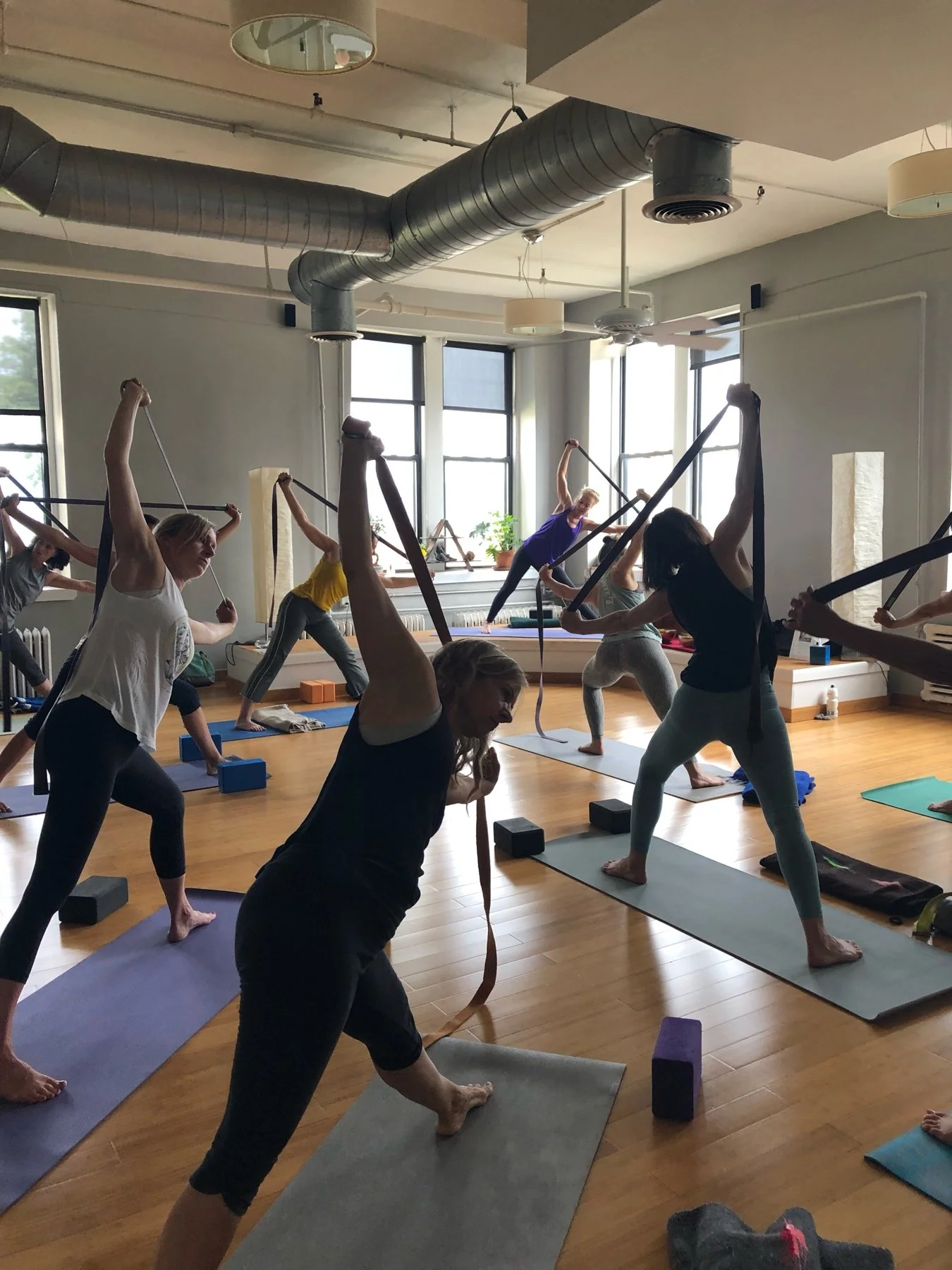
Flexibility is only one piece of that vocabulary
This is where stretching can get confused with mobility.
Being able to passively pull yourself into a position isn't quite the same thing as being able to actively move into—and control—that position.
Imagine lying on your back with a strap around your foot.
You use the strap to pull your leg toward you.
Great. You've accessed that range.
Now take the strap away.
Can you actively move your leg to the same place?
Maybe you can.
Maybe you can't.
Neither answer makes your body good or bad.
It simply gives you information.
I'm much less interested these days in getting bodies into the biggest possible range of motion and much more interested in questions like:
Can you move there?
Can you control yourself there?
Can you produce some force there?
Can you move in and out of that position?
Does that range even matter for what you want to do in your life?
Because you don't need every possible range of motion.
You need a body capable of doing the things you want it to do.
And yes, strength belongs here too
Movement doesn't have to mean stretching.
It can mean pushing your body away from the floor.
Holding yourself up.
Balancing on one leg.
Using your glutes and hamstrings to lift your hips.
Controlling your pelvis while your arms or legs move.
Moving slowly enough that momentum can't do all the work for you.
Using your own bodyweight as resistance is an incredibly accessible place to begin exploring strength.
You don't need to become a weightlifter.
And if you already box, run, lift or train hard, this kind of movement doesn't necessarily replace any of that either.
It can simply give you something different.
Different directions. Different ranges. Different demands. Different information.
Variability, not perfection.
Move the spaces and spots we tend to forget
This is one of my favorite parts of movement practice.
There are parts of our bodies we barely think about until they start talking to us.
When was the last time you intentionally moved your shoulder blades?
Your thoracic spine—the part of your spine behind your rib cage?
Your neck in more directions than “looking down at my phone” and “looking at my computer”?
Your pelvis?
Your feet?
We don't need to label these areas dysfunctional because we haven't been moving them.
We can simply move them.
Slowly.
Curiously.
With attention.
And give our brains another opportunity to map where we are and what we're capable of doing.
That's a big part of how I teach.
This isn’t really about “fixing” your back
Just like your posture doesn't need to be held in one perfect position all day, I don't think movement needs to become another list of rules about what your body should be doing.
There isn't one magical low-back stretch.
There isn't one perfect exercise.
And there isn't one movement practice everyone needs.
I teach movement patterns.
Mobility.
Bodyweight strength. (but also strength with weights strength :))
Balance.
Coordination.
Breath.
Some of what we do might look like yoga.Some of it won't.
The point isn't to perform the perfect pose.
The point is to explore more of what your body can do.
If you sit most of the day and barely move, that might mean introducing your body to movements it hasn't experienced in a while.
If you're already an athlete, runner, boxer or strength-trainer, it might mean exploring ranges, directions and movement patterns that aren't emphasized in your regular training.
And if stretching your low back feels freaking fantastic?
Stretch your low back.
It just doesn't have to be the only tool in the toolbox.
Your body doesn't need another set of rules.
It needs opportunities.
To move.
To adapt.
To get stronger.
To explore.
To pay attention.
To remember:
Oh yeah. I can move this way, too.
Movement can be a wonderful part of caring for your body, but movement teachers don't diagnose or treat pain. New, severe, unexplained or persistent pain—or pain accompanied by concerning symptoms—should be evaluated by an appropriate healthcare professional.
WANT TO EXPLORE THIS IN YOUR BODY?
UPCOMING EXPERINCE
Move Well- Low Back
SATURDAY, OCTOBER 17TH 12-2 PM
Location: Hastings Yoga, Dobbs Ferry, NY
A movement-focused experience exploring the low back and the places around it.
We'll use mobility work, bodyweight strength, breath, balance and varied movement patterns to explore your spine, pelvis, hips, thoracic spine and more.
This isn't about fixing your back or finding the “perfect” stretch.
It's about giving your body more ways to move.